Makely

Let's Make Life Awesome

  • Home
  • Decorating/DIY
    • Create Your Decor
    • Decorate Your Home
    • Paint Your Walls
    • Transform Your Furniture
  • Healthy Living
    • Essential Oils
    • Family Wellness
    • Household Care
  • Project Gallery
  • Contact
You are visiting: Home » Decorating/DIY » Transform Your Furniture » Page 6

Revamping a 1960s Beauty Without Sanding or Priming

by Lindsay Ballard on May 29, 2012 2,005 Comments

This post is sponsored by Rustoleum.
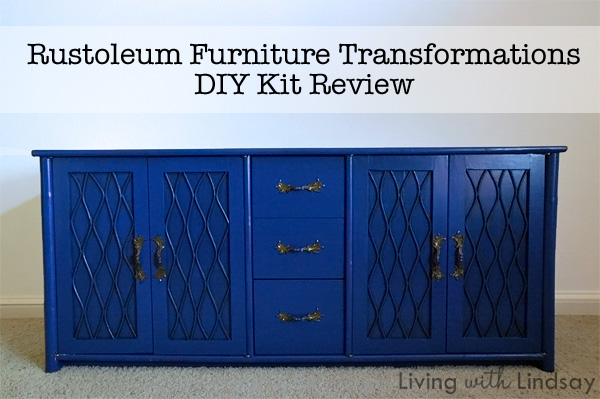
When I received word that Rustoleum had come out with a furniture painting product that required no priming, no stripping, and no sanding of the previous finish, you better believe that I was over the moon.  I spend an extraordinary amount of my free time refinishing furniture, and I was very excited about cutting down on all the time it takes me to remove the finish off of a new/old piece plus priming if I was going to paint.  Last year, I tried the Rustoleum Cabinet Transformations kit that works in much the same way, and when I saw the bright, vivid colors they made available for their furniture kit, I was sold.  Who wouldn’t want to change the color of a piece all while avoiding the hot, messy work that comes with sanding?

My friends at Rustoleum offered to send me a Furniture Transformations kit, and I jumped at the chance.  I chose Midnight out of the available colors.  If you are into more traditional furniture colors, those are available as well.  But, you know how I had to go for bold and vivid.  The kit arrived at my doorstep pre-tinted from Rustoleum, but normally you’d get it tinted at the paint counter at Home Depot or Lowe’s where you buy the kit.
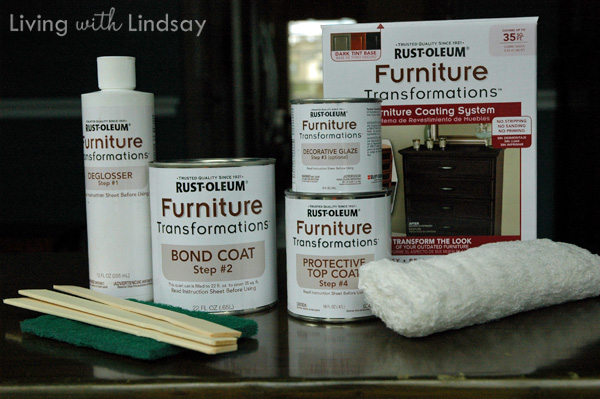
With the exception of some nitrile or latex gloves and a paint brush, the kit comes with everything you need.  There are essentially four steps: 1) Deglosser, 2) Color Coat, 3) Optional Decorative Glaze and 4) Polyurethene.  Only the Color Coat (or “Bond Coat”) has to be tinted in the store.  The kit covers 35 sq ft, which I found to be just enough for my project.

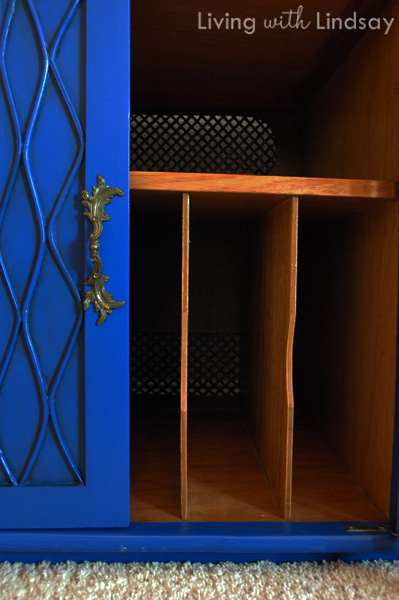
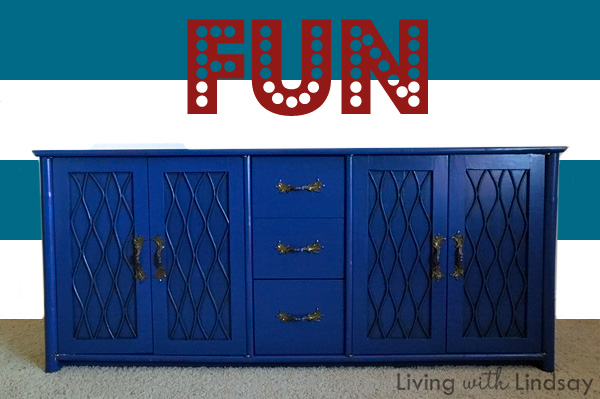
You may remember that I recently purchased a gorgeous early 1960s stereo cabinet from a consignment store.  I wanted to take her from an old, tired stain that had greened over time to a bright, vibrant piece for my kids’ playroom.
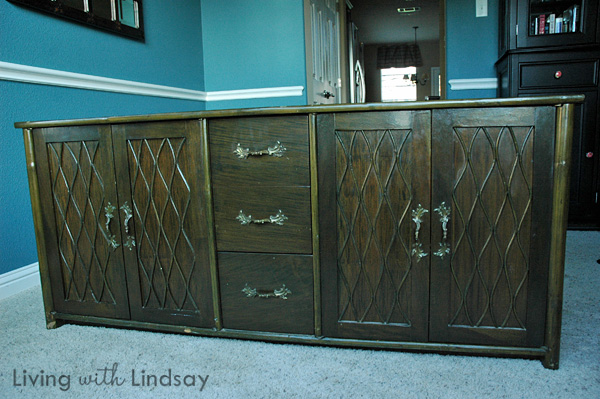
Because I didn’t have to sand, I was able to do the entire transformation indoors, which is a huge plus when you live in Central Texas.  I laid a few dropcloths down in my dining room and set to work.  I removed all of the hardware from the doors and drawers and removed the doors from the hinges.  I gave the hardware a good scrub with Krud Krutter – I wanted to remove any grease and dirt on them, but I still wanted them to maintain their pretty brass tarnish.  I labeled the doors so I would know which one went where when it was time to put it all back together.

The first step of the kit was to use the deglosser, so I squeezed a generous amount onto the provided scouring pad.  A lightly scrubbed all of the surfaces that I was going to paint, and I was surprised to see that both the shiny original finish and a little bit of the old stain came off.  I wiped it down with a wet cloth and let it dry, per the instructions.
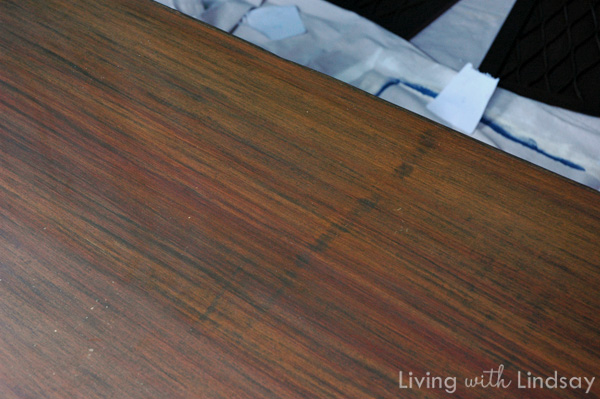
Once that was dry, I used a good quality Purdy brush and applied the Color/Bond Coat.  The instructions call for two coats, and this is what it looked like after the first one.  I’m showing you this so you don’t freak out.
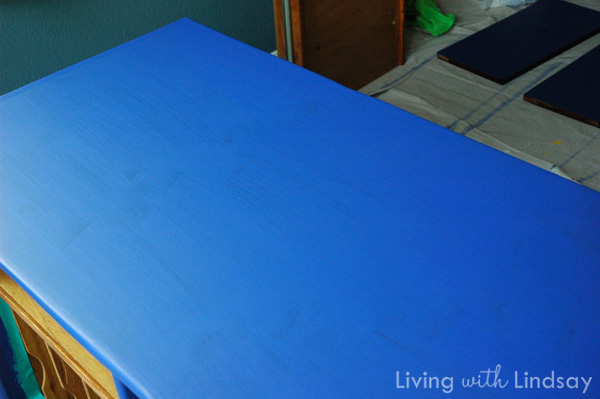
There are definitely visible brush marks and the coverage was uneven.  Most of that disappeared once I applied the second coat.

A note about the Rustoleum Transformation products:  The glaze you can apply on the piece is optional.  However, the Color/Bond Coat is formulated in such a way that there WILL BE SMALL BRUSH STROKES.  That is because the brush strokes give the glaze something to get into.  You can roll or spray your piece ONLY IF you will not be glazing it.

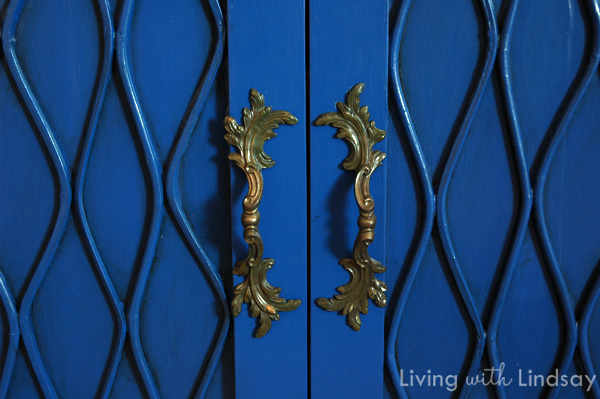
Given my obsession with glaze, you will be surprised to learn that I decided to only glaze the decorative details on the cabinet doors.  I followed the instructions provided, but I fell back into my own tried and true methods – apply with a brush, wipe off with a dry cloth, wipe off with a wet cloth, wipe off with a dry cloth.  It just works better (for me).  I’m not going to lie – it was a HUGE pain to glaze these doors, but it had nothing to do with the product.  There were just so many crevices, but in the end, I’m glad that I did it.  I think it gives the bamboo detailing a lot of dimension.
After the glaze was dry, I was able to move on to the polyurethane (or the “Protective Top Coat”).  Unlike most other polys, it is formulated in such a way that it is thick and dries hard enough that you only need to use one coat.  I was excited by the prospect.  But, I was disappointed in the way the poly dried.  Even when I applied more that I thought I should, it dried so quickly that I couldn’t maintain a wet edge and the product became gummy.  Once that happens, it dries streaky like this.  Yuck.
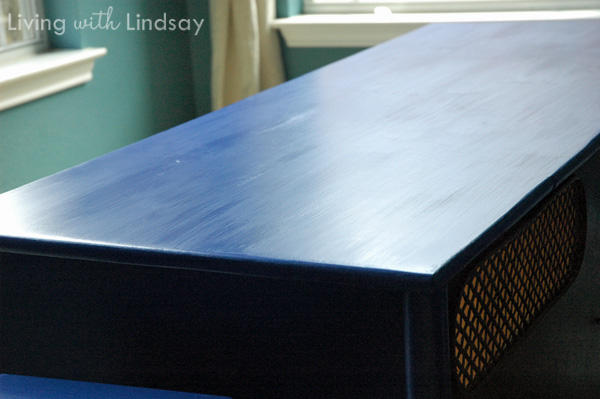
So, I quickly sanded it down with a 220-grit sandpaper and reapplied the poly.  I had the same problem again, even when having more poly on my brush.  I talked to my friends at Rustoleum and asked if I could instead use two coats of my favorite poly (Rustoleum Ultimate Polyurethene in a satin finish).  They said that would be fine.

I’m really not sure what happened with the poly included in the kit.  I was indoors in the air conditioning, so temperature and humidity shouldn’t have been a factor.  I know that I was applying it with the correct amount of product with a good quality brush.  I even tried to roll it, and the poly bubbled very badly.   The last I heard, Rustoleum was looking into whether I received a bad batch of the poly.  I’ve never had any problem with their products before, so it won’t keep me from trying again.

Once the top coat was dry, I was very happy with the kit (other than the poly which I’ll probably end up redoing in the future).  I think the transformation is beautiful, and the fact that I could do it all indoors and in just a few days was a huge win for me.
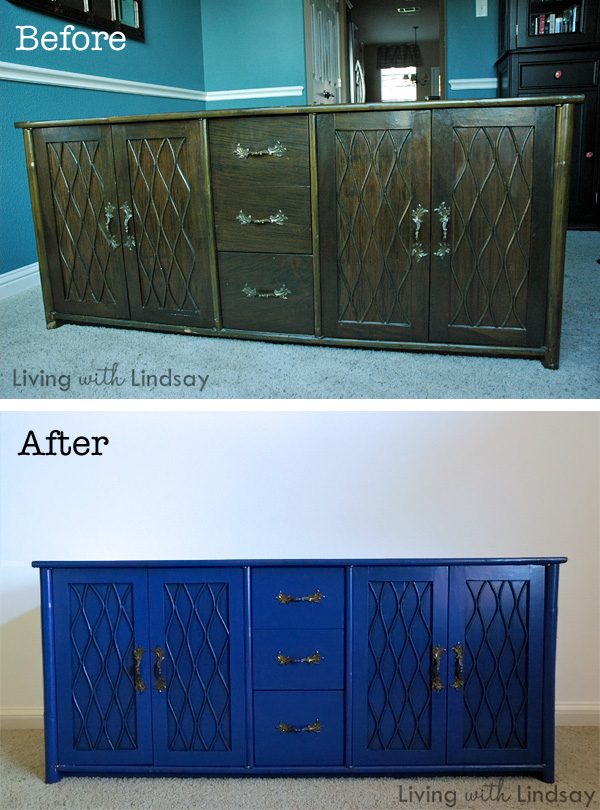
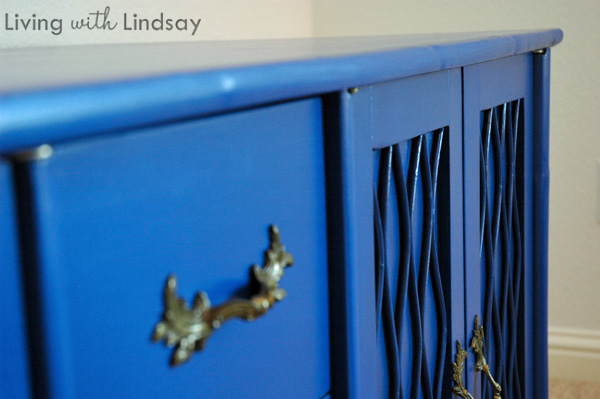
 

Even with the problems I had with the polyurethene, would I still recommend it to you?  Absolutely.  If the color you are wanting to use is available in the Furniture Transformations product, then I would say to go for it.  The kit is $35, which is a steal when you consider the cost of sandpaper, primer and paint.  Plus, your time is worth something, too, y’all.  I would not use the included top coat and instead use two coats of the Ultimate Polyurethene.  That runs you about $10 a can.  So, for under $50 and about 3 days, you can have a gorgeous piece of furniture.

I will update you in the coming months on how well it is holding up.  Tom has already dropped a heavy, iron candle holder on top of it, and there’s not a ding to speak of.  He’s lucky.  Ahem.

In the meantime, here’s a little sneak peek of the mood I’m going for in the kids’ playroom.  It’s going to be bright and colorful and have a vintage carnival feel.  This is just a little mock up of the wall where the cabinet is going to go.  I obviously hasn’t accessorized it yet, as accessories in a playroom should be pretty sparse.  The snazzy beaded chandy will go in here, too.
Have you tried the Rustoleum Furniture Transformation (or Cabinet Transformation) product?  Interested to try it?  Questions?  Let me know.  I am looking forward to trying it again myself!

Rustoleum sent me the Furniture Transformations Kit for the purposes of reviewing it on my blog.  All opinions expressed here are my own.
What I Did Over Christmas Vacation…and for Three Months After That

by Lindsay Ballard on April 3, 2012 1,301 Comments

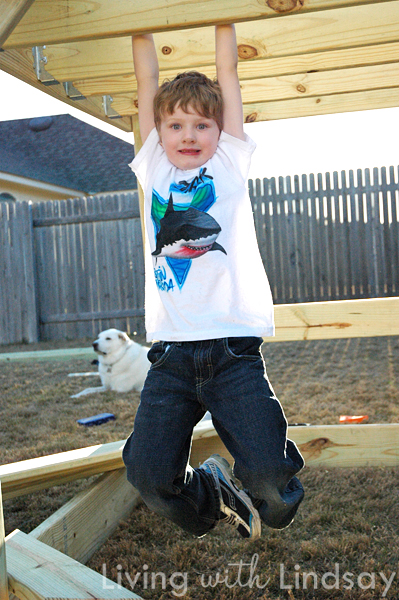
On Christmas morning, our kids woke up to find that Santa Claus had left them a big, wooden playscape for the backyard.  Only they didn’t quite realize that they had received a playscape.  The jolly, fat man had the nerve to leave the bolts and swings and plans, but he didn’t buy and cut the lumber or assemble it himself.  I guess he got lucky in that we are DIYers and were looking forward to putting it together ourselves.

We, I mean Santa, bought a playscape kit online from Detailed Play.  It came with a set of plans, all of the fasteners we would need, and most of the accessories.  We liked that we could select our own grade of lumber and make sure it was constructed properly.  We also liked that it was big enough that our 6-year old could still play on it for many years to come.

The day after Christmas, we rented one of the trucks at Home Depot and brought home a garage full of lumber.  It was a daunting task, but we got it all measured, cut and built in the week between Christmas and New Years Day.  The entire family joined in on the building fun, and it was good “together” time.  And yes, we can wear short sleeves at the very end of December.

So, if all this happened around Christmas, why am I just now talking about it in April?  Well, it’s because what happened after it was built that was the nightmare.

I thought that staining the playscape would be a breeze.  I stained our bed.  I’ve painted (what feels like) hundreds of pieces of furniture.  I had never stained an exterior structure before, but I figured that I wouldn’t screw it up.

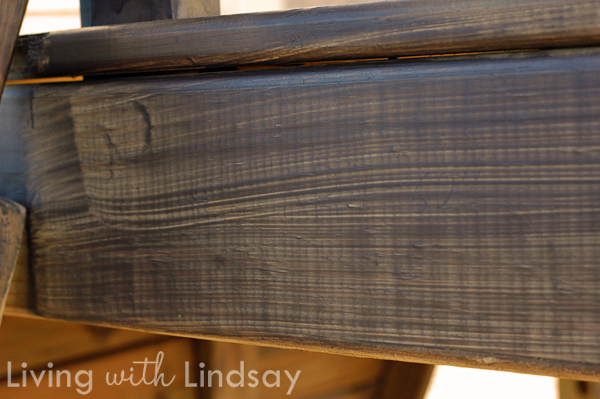
Y’all, it was bad.  It was so, so bad.  I tried to stain using a mitt, a brush and a sprayer, and each technique was worse than the previous.  I used a semi-transparent stain, which was a mistake, and my technique left a lot to be desired.  It dried streaky and splotchy and was so bad that I didn’t want any of my friends to come into my backyard.

I pouted for a few weeks, and then I ran crying to my friends at Rustoleum, who I knew had just released a new line of wood care products.  They talked me off the proverbial ledge, and they suggested some products and techniques to me to fix my awful problem.  Talk about friends with benefits!

One option was to wait until the stain weathered off the playscape, but I wasn’t willing to live with the mess for several years.  So, we decided that I had to strip the stain off the wood and stain again.

To remove the stain, they recommended I use Wolman Deckstrip-ASR.  It’s a stripper that removes weathered or relatively new acrylic or latex stains without scrapping or sanding.  I had my doubts if it would really be that easy, but we gave it a try.

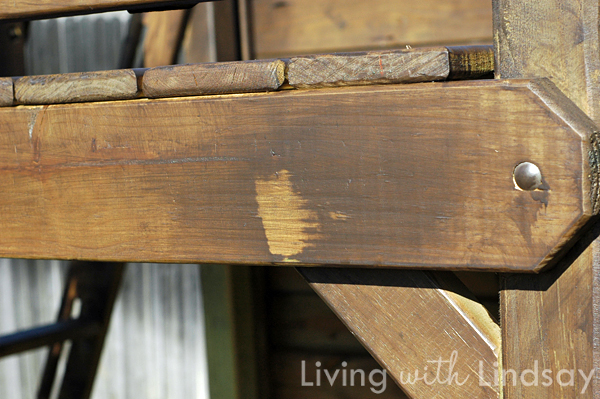
Well, we decided there must be some sort of Harry Potter action going on in the bottle, because the stain just melted off.  We started by applying the stripper with a medium-grade paint brush (i.e. don’t use a nice brush, because the stripper will destroy it), but then we found out that putting the stripper in a spray bottle and just spraying it on was much easier.  After 15 minutes, we’d wash off the stripper with a small power washer that we borrowed from a neighbor. We were concerned that the stripper would kill our grass, but it didn’t at all.  See?  Harry Potter magic, people.

There were a few places where I had applied the original stain extremely heavily, and those areas were harder to strip.  We also could really only lighten the edges of the boards instead of stripping them entirely, but that was fine since we were going to re-stain it.

If you have an outdoor project to strip this spring, like a deck or a playscape, here are some tips:

  • Protect your skin, because the stripper will burn like crazy if it splashes on your skin.  I wore a long sleeved shirt, long paints, rain boots, gloves, and safety goggles.  To protect your face, put on a thick coat of thick lotion (like Cetaphil).  It sounds crazy, but it really helped.
  • Have many pairs of disposable gloves on hand.  I used Nitrile gloves, and threw each pair away after I stripped a section.
  • Wear a respirator if you are spraying the stripper.  Otherwise, you’ll inhale the stripper, and it will hurt.  I speak from experience.
  • Work a small section at a time.  It will take longer to finish, but you’ll get the job completed in one pass.
  • Don’t try to strip areas that are in the direct sunlight.  You need to keep the stripper “wet” for 15 minutes, and it dries quickly in the sun.  Choose a cloudy day to work on the project.
  • Strip over a couple of days.  Using the pressure washer means that your yard will become a swampy, water-logged mess.  We worked a little bit over the course of 3 weekends to keep our yard from getting torn up.

After the yard dried out, it was time to reapply the stain.  Again, my friends at Rustoleum were incredibly helpful in this regard, too.  They suggested that I use their House and Siding Solid Stain.  It’s tintable to 22 colors (I chose Black Walnut) and has a formula they call Cool Touch Technology, which promises to reduce the surface temperature 20 degrees – perfect for those of us who live on the surface of the sun (aka Central Texas).

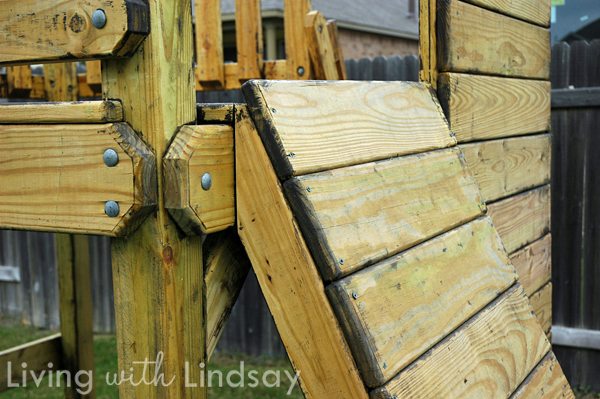
Unlike the previous stain I used, this stain was incredibly easy to apply.  I used another medium-grade paint brush and just brushed it onto the surface.  I could immediately tell that this stain was a million times better for my project that the old stain.  Rustoleum recommends applying 2 coats, but I only did one out of laziness and needing to be finished with the project (after 3 months!).  Only time will tell if that was a bad idea.

If you have an outdoor project to stain this spring, like a deck or a playscape, here are some tips:

  • Pour the stain from the gallon can into a smaller container.  Only fill that container about half way.  When you dip your brush into it, tap it on the side of the container instead of dragging it to remove the stain.  You’ll have more stain on your brush, and it will make it easier to apply it in an even coat.
  • Work when temperatures are between 50 and 90 degrees.  I could definitely tell a difference in the consistency of the stain as the temperature changed from a cool morning to a warm afternoon.  It felt much thicker.  Get your staining finished ASAP if you live in a hot climate, as it might not go on nicely in the heat of the summer.
  • Work when it isn’t supposed to rain for 24 hours.  The day I started staining, we had a freak rain shower that wasn’t forecasted.  On a few parts of the playscape, the stain was removed in a little dot pattern where the raindrops had hit.  I was able to simply reapply the stain in those areas, but it would have been nice to not have to do that.

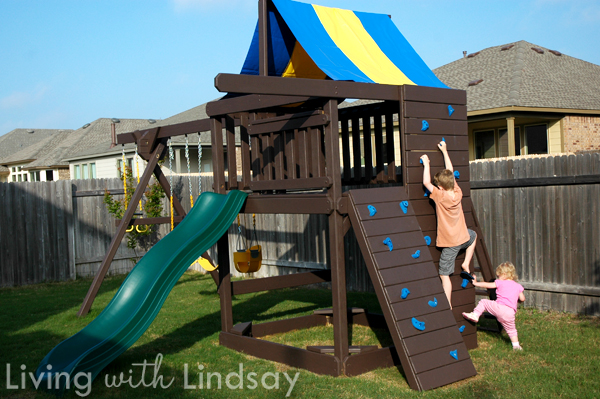
About two hours after applying the last bit of stain (because it was so warm and the stain dried so quickly), we added the accessories and our kids were ready to play.

Look at Emma!  She’s very much a “Monkey See, Monkey Do” type of gal.  At 19 months, she’d climb up that rock wall if she could just figure out how to do it.

I’m very pleased with the way the playscape turned out in the end.  As playscapes go, I think it’s lovely.  But what’s even more lovely are these happy little faces.

Pure joy.  ♥

Have you tackled stripping and staining an outdoor structure?  Did you build your playscape from plans or did you buy a kit that included the lumber?  Share your stories with me in the comments!

Thank you to Rustoleum for providing me with the products to right my wrong.  They did so with the understanding that I would share my experience with their products, but the opinions expressed here are my own.
« Previous Page
Next Page »
  • Email
  • Facebook
  • Instagram
  • Pinterest
  • Twitter

About Makely

Lindsay Ballard is a former college mascot turned political geek turned roller derby playing, DIY fanatic.

Lindsay chronicles her projects, design ideas, and lifestyle tips here at Makely, where she shares tutorials and inspiration. Her DIY designs are bold and graphic, while her spirit is fun and full of color.


Archives

Categories

PRIVACY POLICY
Copyright © 2009-2019 Makely School for Girls | All Rights Reserved | Posts may contain advertising content or affiliate links